

We had never sailed on Chesapeake Bay before. We started out at Edgewater, Maryland, just outside of the capitol of Maryland, and the cutest city I’ve ever seen in my entire life, Annapolis. This time it would be different. Our final destination would be Charleston, South Carolina, starting in Edgewater. And we knew we would need to do the trip in chunks based upon the weather and the sea state. We’ve done overnight passages before, but what we have never done before is going just the two of us and with our dogs.
Normally when we do an overnight passage we have at least one other person with us, just to make the night watches a bit more humane. With more people the shifts on watch can be shorter, allowing for more opportunity to rest in between shifts. In the past we have never had our dogs with us on an overnight run.
When you’re sailing overnight it is DARK. There is very little ambient light, and you cannot tell the difference between the blackness of the water and the blackness of the sky. As a result, we have to be incredibly careful about not losing anyone aboard, it would be impossible to find a human who has the ability to yell and beyond impossible to find a dog.
Let me first tell you about all the safety precautions we take when embarking on a night passage. The humans have harness style lifejackets that we all wear at night. These jackets self-inflate when they get submerged in the water, and we have leashes that we use to clip onto the boat when we are working on deck, so that if we slip we will not fall off the side of the boat into the dark abyss. The jackets also have a water activated light that comes on when the light gets wet. Mine and Todd’s jackets are also equipped with a combination AIS and EPIRB device. The AIS will signal nearby boats that we have a man overboard situation. The EPIRB is an emergency positioning beacon that will notify the US Coast Guard of a man overboard situation. This must be activated manually by the person wearing it, and it will transmit the GPS position to the Coast Guard. Then they send a helicopter out to find that person. The humans also wear a wrist mounted device that is Bluetooth connected to the boat. When it is submerged the connection will break which then causes a very loud alarm to sound and will also record the position on the chart plotter at the helm of where the man overboard took place. It also signals other boats nearby.
The dogs also wear life jackets that are equipped with the water activated lights. They also wear those wrist bands that the humans wear. But dogs don’t have wrists, so we attach them to their collars. Of course, our dogs have ID tags on their jackets and they are microchipped.
This is what our life jacket and tethers look like.

To prepare for the trip we purchased netting that goes all around the boat on the lifelines that circle the decks. However, the netting we bought for this purpose was annoyingly complicated to put on. Todd got the brilliant idea of purchasing badminton nets from Amazon. They were exactly the right height, and 5 of them strung up the sides and across the front of the boat were sufficient to keep the dogs in. We used Velcro straps to secure them and managed to install them in about an hour total. On the back of the boat we have gates that close so the dogs won’t be able to slide off the back of the boat and into the water.
We were ready to set out. We planned to travel from Edgewater, MD to Norfolk, VA which is about 150 nautical miles. We had originally planned to anchor for the night somewhere half way to break up the 36 hour trip. We set out on Saturday early morning with the plan to anchor around sunset, and then set out again to arrive in Norfolk on Sunday night. We had never sailed down Chesapeake Bay and we studied the maps and planned our watch schedule.
This is when we set out from Edgewater in the morning. If you look closely you can see the badminton nets we installed. Bonus: when we get somewhere we can totally host a badminton tournament.

Thomas Point Lighthouse.

Sunset on the Chesapeake Bay.

When we set out some friends of ours in another boat were also setting out to head to Norfolk. They set out earlier than us, and planned to stop in a town along the way as well. We had looked at the map and decided we would stop there too, because we weren’t keen to do the whole overnight passage just the two of us. It was nice that we were able to update each other about our whereabouts and the conditions along the way. It was dark by the time we made the turn to go into that town where our friends on Tiki Tour were going. They hailed us on the radio. The route to get to that anchorage was riddled with crab pots which made navigating in the dark treacherous.
Crab fishing operations will set traps for the crabs on the bottom of the bay. Then there are ropes that run to buoys that float on the surface of the water. This way the boat captain can spot the buoys and know where their crab pots are located. In the dark it is impossible to see these buoys and the risk is to get them entangled around the propellers on the boat. We didn’t even realize that we were in the middle of a densely populated field of crab pots. We pulled out a spot light, and sure enough we were surrounded by them. It was to the point where I think I could have just hopped from one buoy to another they were so close together. We didn’t experience this density of crab pots in the deeper water in the center of the Chesapeake, just as we were headed to shore where the water was shallower.
Tiki Tour reported that the crab pot situation was officially insane. I guess this is why every single restaurant in Maryland serves crab everything, right? Todd and I decided to turn around and head back to deeper water and forego stopping for the night. We decided to continue on to Norfolk and make this our first official overnight passage with just the two of us and the dogs. Then we had to figure out the watch schedule for an overnight run.
Because it would be our first time just the two of us we decided that day time watches would be 6 hours long, and then night watches would be 4 hours long. That means that from 6-12 Todd would be at the wheel and I could rest. Then I would take over at noon and he would rest. Then from 6-10 he would be on watch, then I would go from 10-2, then he would do 2-6 AM, at which point I would start at 6 AM and go back to 6 hour watches.
Doing an overnight watch is way different than a daytime watch. Of course in both situations you have to be vigilant. But at night it feels like there’s more at stake. I sit with my eyes glued to the chartplotter to ensure that our route has adequate depth beneath us so we won’t crash into the bottom of the sea. I am also looking at the chart for obstacles like rocks and reefs and I also want to avoid crashing into. Then there are the other boats. You can only really see them as a tiny point of light on the horizon, and then you can also see them on the radar screen.
When you see other boats on the horizon you can tell by the configuration of the lights which way they are heading. If you can see their red light you can tell that you’re looking at their port side, or left side, so now you can tell that they are crossing your path from right to left. If you see their green light, the other side of the boat is facing you and they are going the opposite way. If you see both green and red you can tell that they are heading toward you. If you just see the white light, they are heading away from you.
At least the radar is more informative. On our Garmin chartplotter I can touch the boats on the screen and get more information. If they are broadcasting their details, which most boats are these days, I can see the name of the boat, the direction they are going and how fast they are going. This information will give me what I need to know if they are heading toward me and I can then hail the on the radio and discuss a plan for safely passing each other.
So, on a night watch I am constantly checking the screen to make sure everyone is staying the hell away from me and I won’t hit anything. I will admit that things don’t change that quickly when traveling by boat so I am able to read while on watch. I read a page, check all the screens, do a look around… then read another page, check the screens, do a look around. And I do this for 4 hours until my watch is over and I can go to sleep.
Once we got out of crab pot heaven and back into the center of the bay the trip to Norfolk went very smoothly. We fed the dogs, we fed ourselves. We went on watch, we slept when off watch. We walked each dog one by one to the front of the boat so they could attend their business meetings.
We set the anchor and stayed a few days in Norfolk so that Todd could work. I job searched, went ashore to do some grocery shopping. We found a dog park in Norfolk and took the dogs on a field trip a few times.
The Wisconsin is docked in Norfolk, and they light it up for Christmas.

While we were in Norfolk, they were putting up all the Christmas lights. Every night there were more.

Norfolk is home to a massive Navy installation. There were ships of all sorts docked and getting maintained. This one was at sunrise as we were leaving Norfolk. Sort of makes you want to call Kenny Loggins and have him serande you, don't it?

We watched PredictWind for our weather window. We planned our next chunk of the trip to go to Beaufort, North Carolina from Norfolk. This would be a trickier passage, again around 36 hours. What makes this run trickier is the introduction of the Gulf Stream.
This is the route we took to get to Beaufort, which is right next door to Morehead City. This looks like a simple enough run. Believe me, it takes planning.

The Gulf Stream is a massive current that travels up the coast from Florida all the way to Cape Hatteras. It travels from the south, and we would be traveling right into it. Fortunately there is a space between the edge of the current and the shore. Unfortunately that space around the pointiest part of North Carolina is very thin and the North Carolina shore at that point is riddled with reefs and shoals which makes traveling too close to shore very dangerous. We had to plan it just right where the wind wouldn’t slam into the current of the Gulf Stream and make an uncomfortable ride. We studied our maps and our forecasts and set out on Thursday November 13th.
Another 36 hours. Judging by the radar lots of other boats were taking advantage of this weather window too. There were so many around us on the screen which make night watches feel less lonely. I could see the lights from other boats as tiny little dots on the horizon. We plotted our waypoints around Cape Hatteras very carefully and managed to make it safely to Beaufort with zero drama. I remember finishing my watch at 4 in the morning and going right to bed. The midnight to 4 watch is challenging for me, as I am an Olympic level sleeper. I watched a show on my tablet with my headphones on while Todd slept on the daybed nearby. A few hours after my watch ended and the sun came up. I was exhausted and jammed a pillow over my eyes to try to catch more sleep. When I woke I ordered an eye mask that would be waiting at home for me to take with me on the next trip.
When we arrived in Beaufort on Friday night we learned that the annual Pirate Festival was that weekend. Beaufort was a popular hang out for pirates like Blackbeard back in the day. On Saturday pirate boats rowed through the harbor, cannons were fired, and then we went ashore to wander among the vendor tents with the dogs in tow, listened to live music and people watched all day long.
These pirates rowed all through the harbor while cannons "fired" at them from ashore.

Some pirates, probably Blackbeard, coming to town to wreak havoc.

Trapper and Phin on a dinghy ride deeper into the harbor.
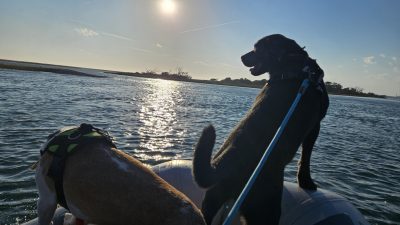
Todd on a dinghy ride in the harbor.

The last chunk of the trip started on Monday the 16th. This one would be a bit shorter and would take us to Charleston, South Carolina. We spent the first few days there anchored in front of the aircraft carrier the Yorktown in the Cooper River. We enjoyed peaceful days and nights at anchor there until the 20th when we were due to dock at the Charleston Maritime Center, where we planned to dock the boat until February when we’d return to Charleston and pick up the next leg of the adventure.

And of course on the long drive back to Rhode Island we passed this iconic stop.

BJ Knapp is the author of Beside the Music, available for purchase here. Please sign up for the Backstage with BJ Knapp mailing list to get updates on events, signings, dog pictures and so much more.